[Statistics 1 🔢] Probabilities
![[Statistics 1 🔢] Probabilities](https://cdn.hashnode.com/res/hashnode/image/upload/v1691931002250/1f9fdc25-28be-4d78-936d-56b3b3fc096b.png)
💻 AI Developer & Researcher @ Geologix
🏛️ UCL MEng Computer Science (2019 - 23).
🏛️ UCL MSc AI for Sustainable Development (2023 - 24)
🥇 Microsoft Golden Global Ambassador (2023 - 24)🏆
🌟Key Terms
Independent
$$x_i, x_j$$
Two variables are independent when a joint distribution could be expressed as a product between two marginal distributions.
$$P(x_i, x_j) = P(x_i)P(x_j)$$
Bayes Theorem

Bayes Theorem or Bayern Munich? 🤔
The probability of an event (x) conditioned on a known event (y) is defined as:
$$P(x | y)=\frac{P(x,y)}{P(y)}$$
Exception
The exceptional condition is when y = 0; the probability is not defined.
Alternative Format
Bayes theorem could be expressed in an alternative format:
$$P(x|y)=\frac{P(y|x)P(x)}{P(y)}$$
Hidden Markov Model
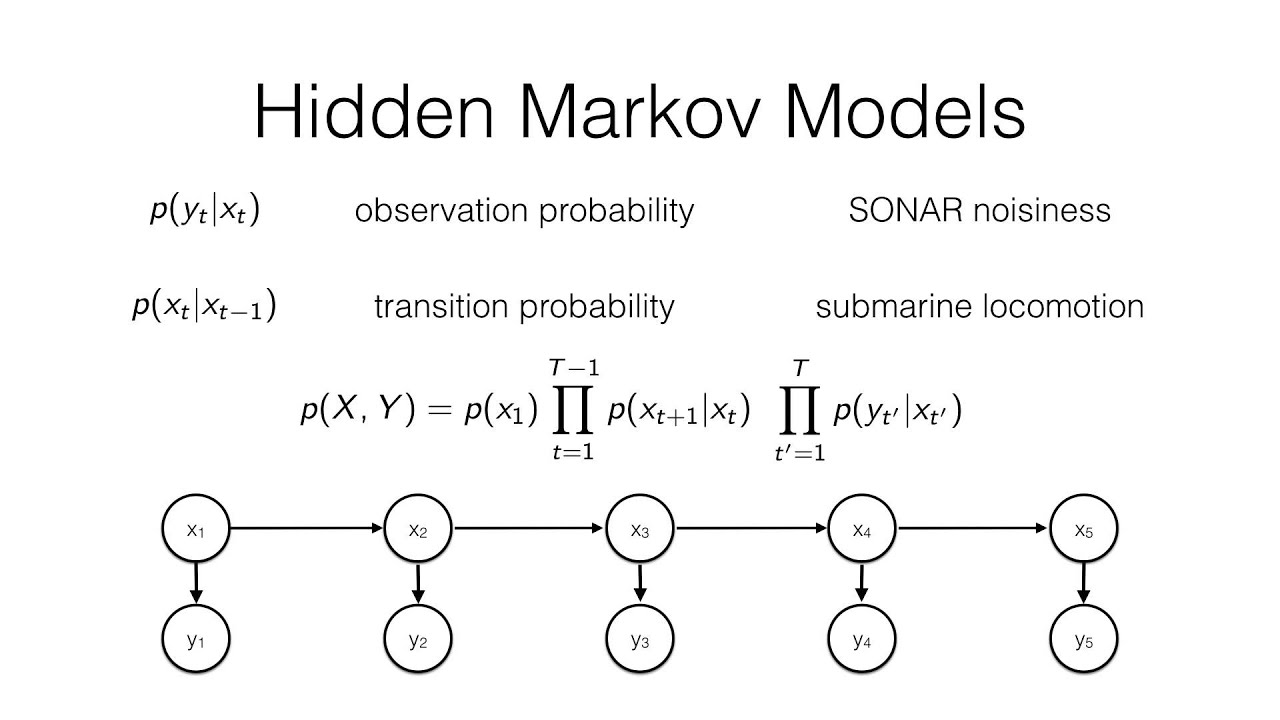
A Hidden Markov Model contains a series of visible and hidden states:
$$V = (v_1,v_2,...,v_T)$$
$$ H=(h_1,h_2,...,h_T)$$
💡Common Questions
Could a belief network be represented as a directed acyclic graph (DAG)?
If there is an edge between two variables in a DAG, does it mean the variables are dependent?
Define an EM (Expectation Maximisation) algorithm.
📖 Answer 1
When the DAG is presented as:
$$X\rightarrow Y$$
The DAG shows that the Y node is dependent on the X node s.t., the probability distribution is expressed as:
$$P(Y|X)$$
If the following condition holds for every x value:
$$P(Y|X)=P(Y)$$
It is determined that the Y node and the X node are independent even though they are connected.
📖 Answer 2
⏳IN PROGRESS 🔃
📖 Answer 3
💻An EM algorithm computes the maximum likelihood function using an iterative cycle that executes the E and M steps until the parameters converge to the peak value.
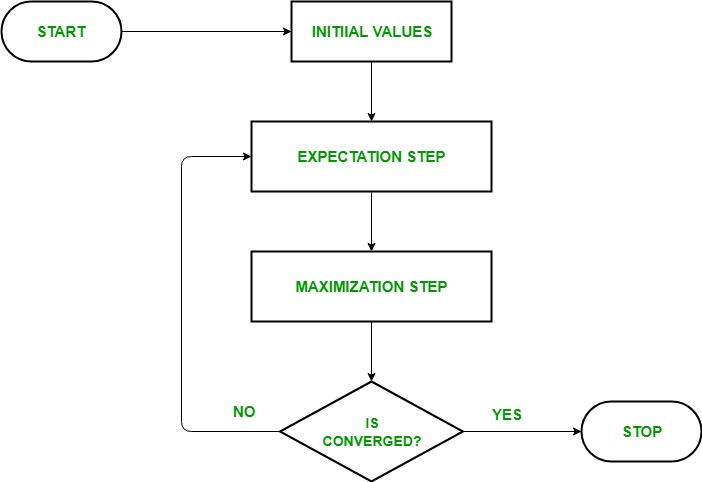
EM-algorithm iterates until the parameters converge to a maximum value:
E-step uses the current parameters to calculate a distribution that maximises the likelihood.
M-step uses the derived distribution from the E-step to update the parameters, maximising the likelihood.